The international financial center is the foundation for the country to enter an era of national development.
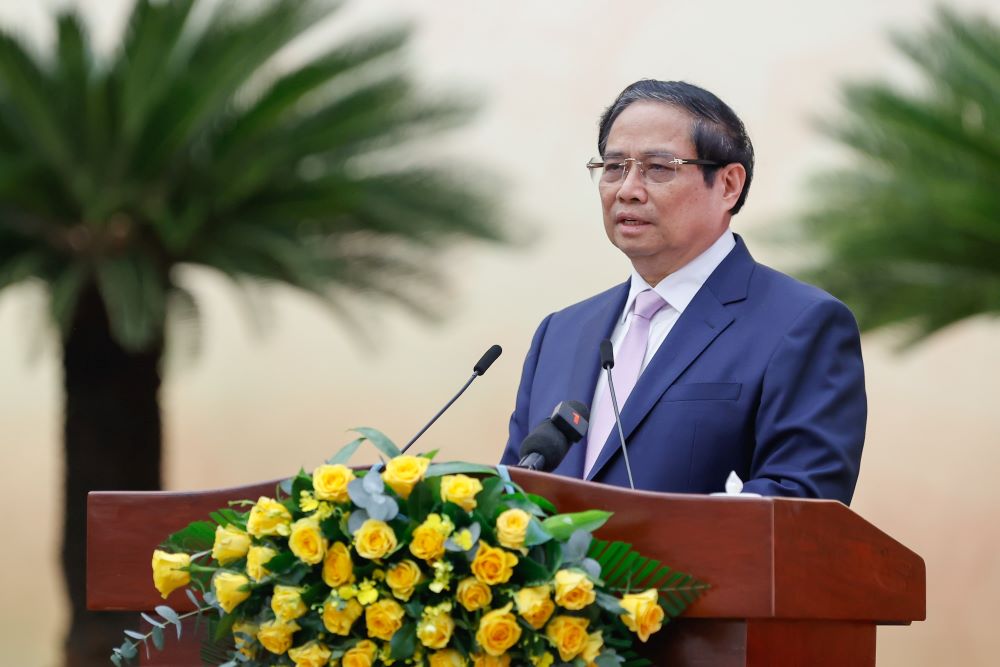
Prime Minister Phạm Minh Chính presided over the conference. Attending were Standing Deputy Prime Minister Nguyễn Hòa Bình; Secretary of Ho Chi Minh City Party Committee Nguyễn Văn Nên; Minister of National Defense Phan Văn Giang; Minister of Public Security Lương Tam Quang; Central Party Secretary and Supreme People’s Court President Lê Minh Trí; Minister of Planning and Investment Nguyễn Chí Dũng; Secretary of Da Nang City Party Committee Nguyễn Văn Quảng; Ho Chi Minh City People’s Committee Chairman Phan Văn Mãi; and representatives from businesses, diplomatic agencies, economic associations, and international experts.
The international financial center creates a “push” and new momentum to promote development.
The conference is meaningful, marking an important step in implementing the country’s development strategy; creating a “push” and new motivation to promote development not only for Ho Chi Minh City and Da Nang but also for the entire nation, contributing significantly to the successful implementation of the XIII National Party Congress Resolution, laying the foundation for the country to enter a new era, an era of prosperity and strength for the nation.
At the conference, Minister of Planning and Investment Nguyen Chi Dung presented the Politburo’s Conclusion Announcement, the Government’s Resolution issuing an action plan to implement the Politburo’s conclusion, and the Prime Minister’s decision to establish the Steering Committee for the Regional and International Financial Center in Vietnam, headed by the Prime Minister.
Secretary of the Ho Chi Minh City Party Committee Nguyen Van Nen and Secretary of the Da Nang City Party Committee Nguyen Van Quang spoke about the preparations of the two cities to develop a financial center, the solutions for implementing the action plan, and the decision to establish a steering committee for the financial center in each city.
Then, the leaders of the Ministry of Finance presented proposals for developing the capital market at the financial center, the leaders of the State Bank of Vietnam discussed the development of the monetary and banking sector within the financial center, the leaders of the Ministry of Justice presented on developing dispute resolution mechanisms for the financial center, and the leaders of the Ministry of Information and Communications discussed developing digital infrastructure for the financial center.
Ms. Alexandra Smith, the British Consul General in Ho Chi Minh City, and Mr. Rich McClellan, the Country Director of the Tony Blair Institute for Global Change (TBI) in Vietnam, also shared about the London Financial Center (UK) and collaborative activities to contribute to the development of the financial center in Vietnam.
According to Announcement No. 47-TB/TW dated November 15, 2024, the Politburo has approved the establishment of a comprehensive international financial center in Ho Chi Minh City and a regional financial center in Da Nang.
According to the Politburo’s conclusion, the financial centers will apply a special management mechanism, superior to current regulations, with a competitive nature, but must be accompanied by appropriate supervision and risk management mechanisms; working while gaining experience, not rushing but also not being perfectionist, to seize opportunities; firmly abandoning the mindset of “if it cannot be managed, then ban it.”
Vietnam meets all five conditions to establish an international financial center
Speaking at the conference, Prime Minister Phạm Minh Chính highly appreciated the strong attendance of leaders from ministries, sectors, and localities, as well as the delegates. The contributions, proposals, and specific commitments all demonstrated a high level of determination, responsibility, and solidarity in building and developing a financial center in Vietnam. Overcoming years of devastation caused by war, embargoes, and isolation, after nearly 40 years of progress…
Prime Minister Phạm Minh Chính affirmed that 2025 is a year of particularly important significance, marking the 95th anniversary of the founding of the Communist Party, the 50th anniversary of the liberation of the South and national reunification, the 135th anniversary of President Hồ Chí Minh’s birth, and the 80th anniversary of the founding of the nation. At the same time, efforts will continue to streamline the administrative apparatus to be “lean, efficient, effective, and impactful,” while organizing Party congresses at all levels leading up to the 14th National Congress of the Communist Party. The year 2025 also marks the final year of implementing the 2021–2025 five-year socio-economic development plan, serving as a period of acceleration and breakthrough to lay the foundation for double-digit growth in the coming years. The Prime Minister emphasized that Vietnam will continue to prioritize growth while maintaining macroeconomic stability, controlling inflation, ensuring major economic balances, improving social welfare, and steadily enhancing the living standards of the people.
To achieve these goals, Vietnam will continue to advance its three strategic breakthroughs—institutions, infrastructure, and human resources—while restructuring the economy in tandem with transforming the growth model, improving productivity, quality, efficiency, resilience, and competitiveness. The country will also tap into new development spaces such as outer space, underground space, and maritime space. At the same time, it will renew traditional growth drivers (investment, consumption, and exports) and strongly promote new ones such as the digital economy, green economy, circular economy, sharing economy, knowledge economy, and night-time economy. In particular, Vietnam will focus on developing semiconductors, artificial intelligence (AI), cloud computing, and the Internet of Things, aiming to leapfrog, catch up, move alongside, and surpass global advancements.
The Prime Minister outlined several specific targets for 2025, including completing at least 3,000 km of expressways and establishing a continuous expressway network from Cao Bằng to Cà Mau; commencing construction of the Lào Cai – Hà Nội – Hải Phòng railway; preparing the North–South high-speed railway project; and implementing urban railway systems in Hà Nội and Ho Chi Minh City, along with major airport and seaport projects.
To accomplish these objectives, Vietnam will require substantial development capital and must strongly mobilize both direct and indirect investment sources. Currently, total social investment accounts for about 33–35% of GDP; in the coming years, to achieve double-digit growth, this ratio needs to increase to 40–45% of GDP, with annual investment capital of approximately 4–5 quadrillion VND, especially for strategic infrastructure. Therefore, the development of regional and international financial centers in Ho Chi Minh City and Da Nang is of great importance.
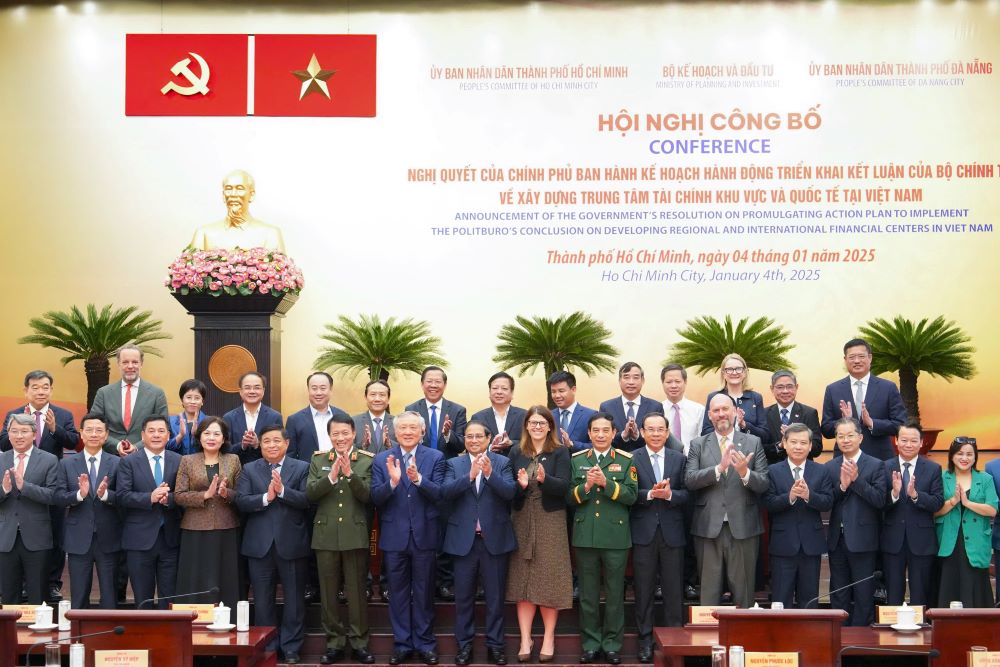
Prime Minister Phạm Minh Chính affirmed that establishing regional and international financial centers is an inevitable and objective requirement in the new stage of development, and that Vietnam now possesses all five necessary conditions to develop a modern financial market toward forming such centers.
First, Vietnam’s GDP in 2024 is estimated at around USD 470 billion, ranking approximately 33rd–34th globally, with GDP per capita of about USD 4,600–4,700. With strong economic growth in recent years, along with macroeconomic stability, controlled inflation, and well-balanced major economic indicators, Vietnam aims for at least 8% GDP growth in 2025 and strives for double-digit growth in the years ahead.
Second, the country’s strategic breakthroughs have achieved very positive results, moving toward more open institutions, seamless infrastructure, and smart governance.
Third, stock market capitalization has reached nearly VND 7.2 quadrillion, up 21.2% compared to the end of 2023, equivalent to about 70.4% of the estimated GDP in 2023. The stock market has maintained double-digit growth—the highest in the region.
Fourth, Vietnam has a highly open and deeply integrated economy, having signed 17 free trade agreements with more than 65 leading economies worldwide. Its total import-export turnover is around USD 800 billion, approximately 1.7 times its GDP.
Fifth, the country enjoys political stability, social order and safety, a peaceful life for its people, and an environment conducive to peace, cooperation, and development.
In addition, Vietnam holds a strategic geographic and geopolitical position in one of the world’s most dynamic and innovative regions, with a time zone distinct from 21 of the world’s largest financial centers.
The Prime Minister noted that the early development of regional and international financial centers would bring five key benefits: connecting Vietnam to global financial markets; attracting foreign financial institutions and generating new resources while enhancing existing ones; capitalizing on the shift of international investment flows to support socio-economic development; promoting a more efficient financial market aligned with international standards; and creating new momentum and breakthroughs for development.
He emphasized that building regional and international financial centers in Vietnam is an inevitable and objective requirement in this new phase of development—a phase of rising toward prosperity, civilization, and wealth, with increasingly improved living standards and happiness for the people.
“This is a new and challenging task, but no matter how difficult it is, it must be done,” the Prime Minister stated, stressing the need to learn from international experience, adapt global best practices to Vietnam’s context, focus on high-quality human resource development, build modern infrastructure, enhance technology and smart governance capacity, and promote unity among government agencies, citizens, and businesses.
He called on Ho Chi Minh City and Da Nang to swiftly develop specific mechanisms and policies, focusing on resource mobilization, human resource training, technology development and transfer, and smart governance. At the same time, ministries and sectors should continue to support and work closely with the two cities in drafting legal documents and establishing a regulatory framework. The Prime Minister also expressed his hope that international partners would continue to accompany Vietnam, share experience, propose policies, and support in mobilizing financial and human resources to accelerate the formation of these financial centers.
“Once the mindset is clear, determination must be higher, efforts greater, and actions more decisive; focus only on doing, not retreating; say no to negativity, excuses, or empty promises; act while learning and gradually expand, without perfectionism or haste; complete each task thoroughly; assign clear responsibilities—clear people, clear tasks, clear timelines, clear accountability, and clear outcomes,” the Prime Minister emphasized.