
“Fast application processing is a key factor in the success of entrepreneurs coming to Canada through our federal business programs. These necessary changes will put the Start-Up Visa Program and the Self-Employed Persons Program on track for faster processing times as we move toward further reforms to make these programs more sustainable and efficient in the long term.”
– Mr. Marc Miller, Minister of Immigration, Refugees and Citizenship Canada.

On November 1, 2023, Immigration, Refugees and Citizenship Canada (IRCC) announced its Immigration Levels Plan for 2024–2026. Canada aims to welcome 485,000 new permanent residents in 2024, 500,000 in 2025, and maintain a stable level of 500,000 in 2026.
Among the hundreds of thousands of immigration applications under various pathways, the Federal Business Immigration programs—including the Canada Start-Up Visa (SUV) and the Self-Employed Persons Program—are allocated a target of 5,000 to 6,000 applications per year.
Major changes in the Canada Start-Up Visa Program
As one of Canada’s key immigration programs, it offers three investment pathways: Venture Capital funds, Angel Investors, and Business Incubators. In 2023 alone, more than 4,000 applications were submitted, and 8 out of 10 start-up projects partnered with business incubators were approved.
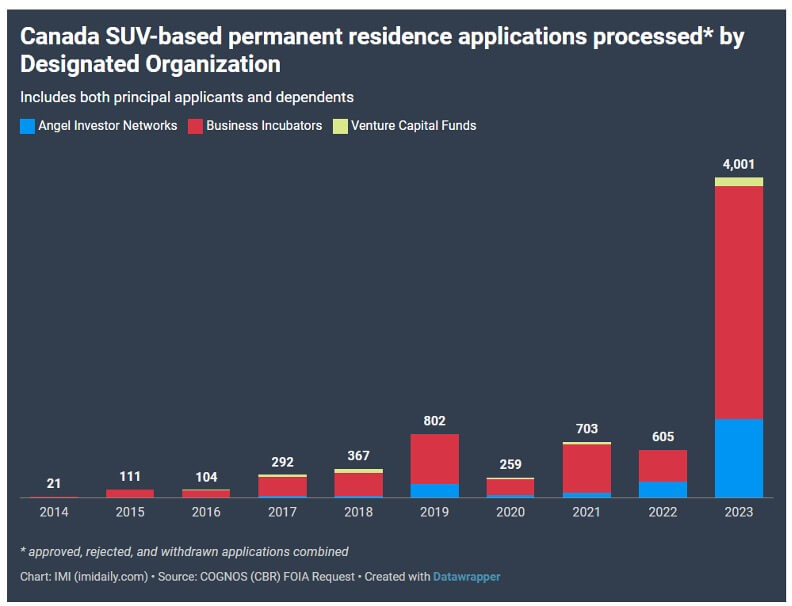
- The approval rate for business incubators is 82%, with over 2,900 applications
- The approval rate for venture capital funds is 76%, with 108 applications
- The approval rate for angel investors is 76%, with nearly 1,000 applications
After more than 10 years of encouraging immigration, the Canadian government has recently introduced significant changes to the Canada Start-Up Visa (SUV) program to shorten processing times and address the backlog accumulated over the years. On April 29, 2024, Mr. Marc Miller, Minister of Immigration, Refugees and Citizenship Canada (IRCC), announced several important changes to the SUV program, effective from April 30, 2024.
The first change is the introduction of a cap on the number of permanent residence (PR) applications that designated organizations can accept under the SUV category. Each designated organization may now support a maximum of 10 start-up projects per year. This reform aims to encourage designated entities to focus on a smaller number of more selective, innovative, and high-quality business projects.
Another key change is the prioritization of applications supported by capital from Canadian sources or organizations that are members of Canada’s Tech Network.
These changes have a significant impact on applicants and the overall SUV program:
- First, the introduction of application caps is expected to increase competition among entrepreneurs seeking support from designated organizations. With a limited number of Letters of Support (LOS), applicants will need to present more compelling and innovative business proposals to stand out and secure backing.
- Second, the government’s decision to impose these limits reflects its commitment to addressing backlogs and improving the overall integrity of the SUV program. By limiting the number of applications, the government aims to streamline processing times and ensure a more efficient system. This focus on efficiency and integrity also suggests that further reforms may be introduced in the future to enhance the program’s sustainability and effectiveness.

Frequently Asked Questions:
Below are some common questions to provide further insight into the recent policy changes, including their effects on current and future SUV applicants.
1. Does this cap mean fewer start-up entrepreneurs will be able to apply for permanent residence in Canada?
No, this cap does not reduce the number of start-up entrepreneurs becoming permanent residents. As outlined in the Government of Canada’s Immigration Levels Plan 2024–2026, the SUV program aims to admit 5,000–6,000 applicants per year.
2. When does this cap take effect and how long will it apply?
The cap took effect on April 30, 2024, and will remain in place until the end of 2026.
3. What happens to applicants who have not yet submitted their PR application but received a Letter of Support before April 30, 2024?
Investors who obtained a Letter of Support before April 30, 2024, will be allowed to submit their applications through the IRCC Permanent Residence Portal until November 1, 2024.
4. With the cap in place, which applications will IRCC process?
Permanent residence applications received after April 30, 2024, that meet the cap requirements will be processed. Applications received before that date will also continue to be processed.
5. Will PR applications submitted before April 30, 2024 still be processed?
Yes, applications submitted to IRCC before April 30, 2024 will continue to be processed.
6. Does IRCC still accept group applications (team-based start-ups)?
Yes, group applications are still accepted. In fact, it is expected that more applicants will choose the team-based approach, as it allows them to combine diverse skills, backgrounds, and experiences, leveraging collective expertise and resources to build stronger and more competitive business models.

Recent changes to the Canada Start-Up Visa Program aim to reduce the application backlog and improve processing times. While the introduction of caps on the number of applications per designated organization may lead to increased competition among SUV applicants, those with strong Canadian backing and innovative business proposals are likely to benefit from faster processing.
If you are an investor seeking support in connecting with a business incubator—especially in light of the recent application limits—we are fully equipped to provide the necessary resources.